
Titanium Insulated Water Bottle: A Practical Buying Guide
A titanium insulated water bottle can be appealing when low carry weight, a clean interior material and temperature control all matter. But “titanium,” “double-wall” and “insulated” do not answer every buying question. Capacity, dimensions, lid design, verified insulation performance and cleaning access still determine whether a bottle fits your daily routine.
This guide uses the current AVINOTI Galaxy Series Titanium Insulated Bottle as a concrete example. It separates facts confirmed by the product listing from specifications that a careful shopper should verify before ordering.
Quick answer: what should you check first?
Start with the information that changes day-to-day usability:
- Confirm the bottle’s capacity and exterior dimensions.
- Ask whether the double-wall construction is vacuum insulated.
- Check the empty weight instead of relying only on “lightweight.”
- Confirm how the lid seals and whether replacement seals are available.
- Look for a documented hot-and-cold test duration and test conditions.
- Check the mouth opening, cleaning method and drink restrictions.
- Review the return and warranty terms before comparing price.
The current AVINOTI listing confirms a pure titanium interior, double-wall construction, five color variants and a listed price of $100. It does not currently publish capacity, dimensions, empty weight or a timed temperature-retention claim. Those missing values should be verified rather than guessed.
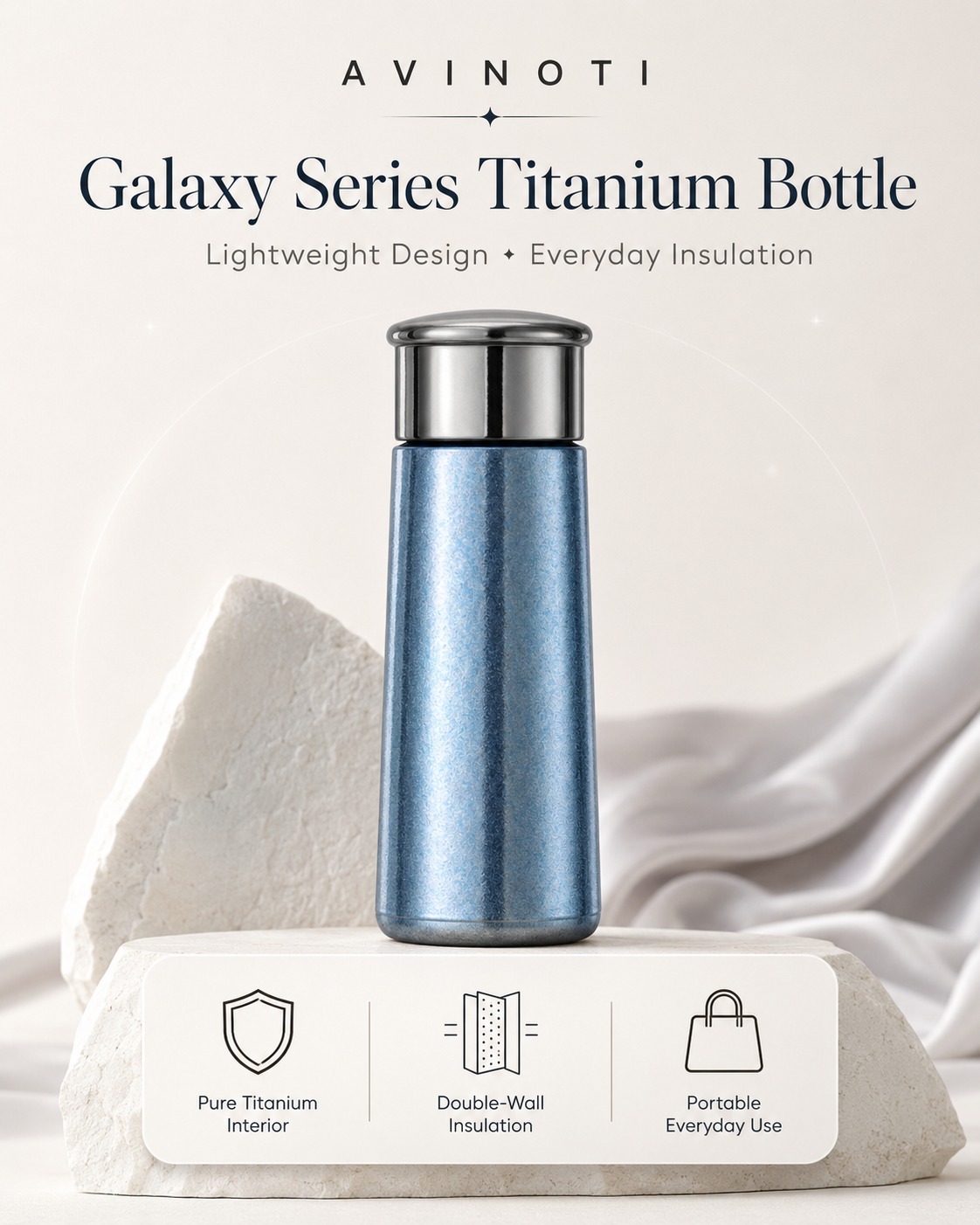
What the current AVINOTI listing confirms
The table below distinguishes listing facts from buyer checks. This matters because product names often combine material, design and performance language without publishing every measurement needed for a fair comparison.
| Buying factor | What the listing confirms | What to verify before buying |
|---|---|---|
| Material | Pure titanium interior | Whether all drink-contact surfaces are titanium and what material is used in the lid and seal |
| Construction | Double-wall structure | Whether the gap is vacuum insulated and how performance was tested |
| Positioning | Lightweight daily hot-or-cold drink bottle | Exact empty weight in grams or ounces |
| Colors | Galaxy Blue, Titanium Silver, Rose Pink, Champagne Gold and Emerald Green | Whether the selected color is currently available |
| Price | $100 across the five listed variants | Shipping cost, return terms and warranty coverage |
| Capacity | Not stated in the current product record | Capacity in milliliters or fluid ounces |
| Dimensions | Not stated in the current product record | Height, widest diameter and cupholder or bag-pocket fit |
You can review the current variants and product images on the AVINOTI Galaxy Series Titanium Insulated Bottle product page. Check the live page again at the time of purchase because price and availability can change.
Double-wall is not automatically the same as vacuum insulated
A double-wall bottle has an inner wall and an outer wall. A vacuum-insulated bottle also removes most of the air between those walls to reduce heat transfer. Product pages sometimes use “double-wall” and “vacuum insulated” as if they were interchangeable, but a buyer should look for an explicit vacuum specification or a documented performance test.
This distinction affects expectations. A double-wall design may reduce how quickly the exterior feels hot or cold, yet it does not by itself prove that a drink will remain at a particular temperature for a particular number of hours. A credible retention claim should identify the starting temperature, room conditions, time interval, lid position and final measurement.
The AVINOTI product record confirms double-wall construction but does not state “vacuum insulated” or publish timed test results. Treat insulation duration as an open question until the live listing or customer support provides those details. That is more useful than repeating a generic all-day claim that is not supported by the current product data.
Match capacity and dimensions to your routine
Capacity is one of the simplest ways to eliminate the wrong bottle. A smaller bottle may be easier to carry but requires more refills. A larger bottle reduces refills but can become awkward in a work bag, side pocket or vehicle cupholder.
Before ordering, write down where the bottle must fit:
- Measure the height and diameter of your usual cupholder.
- Measure the opening and depth of your backpack or tote pocket.
- Decide whether the bottle must fit below a coffee machine or water dispenser.
- Estimate how much you normally drink between refill opportunities.
- Remember that a wide bottle can feel bulky even when its total weight is low.
The current AVINOTI record does not state capacity or exterior dimensions. Ask for both measurements and compare them with your own bag or cupholder rather than assuming that a travel-oriented product name guarantees the fit.
Compare measured weight, not material reputation
Titanium is often selected for products where strength and lower mass are important, but a complete bottle includes more than the inner wall. The outer wall, neck, base, cap, gasket and decorative finish all contribute to the final weight. Double-wall construction also uses more material than a single-wall bottle.
For that reason, “titanium” and “lightweight” should lead to a request for a number, not a conclusion. Compare empty weights at the same capacity. If two bottles hold different volumes, calculate weight per unit of capacity or simply decide which total filled weight you are comfortable carrying.
The practical test is straightforward: add the empty bottle weight to the weight of the drink. Water adds roughly one kilogram per liter, so liquid can outweigh the container by a wide margin. A very light shell will not make a large filled bottle feel small.
The AVINOTI listing describes the Galaxy Series as lightweight but does not publish grams or ounces. Verify the exact value if weight is a primary reason for choosing titanium.
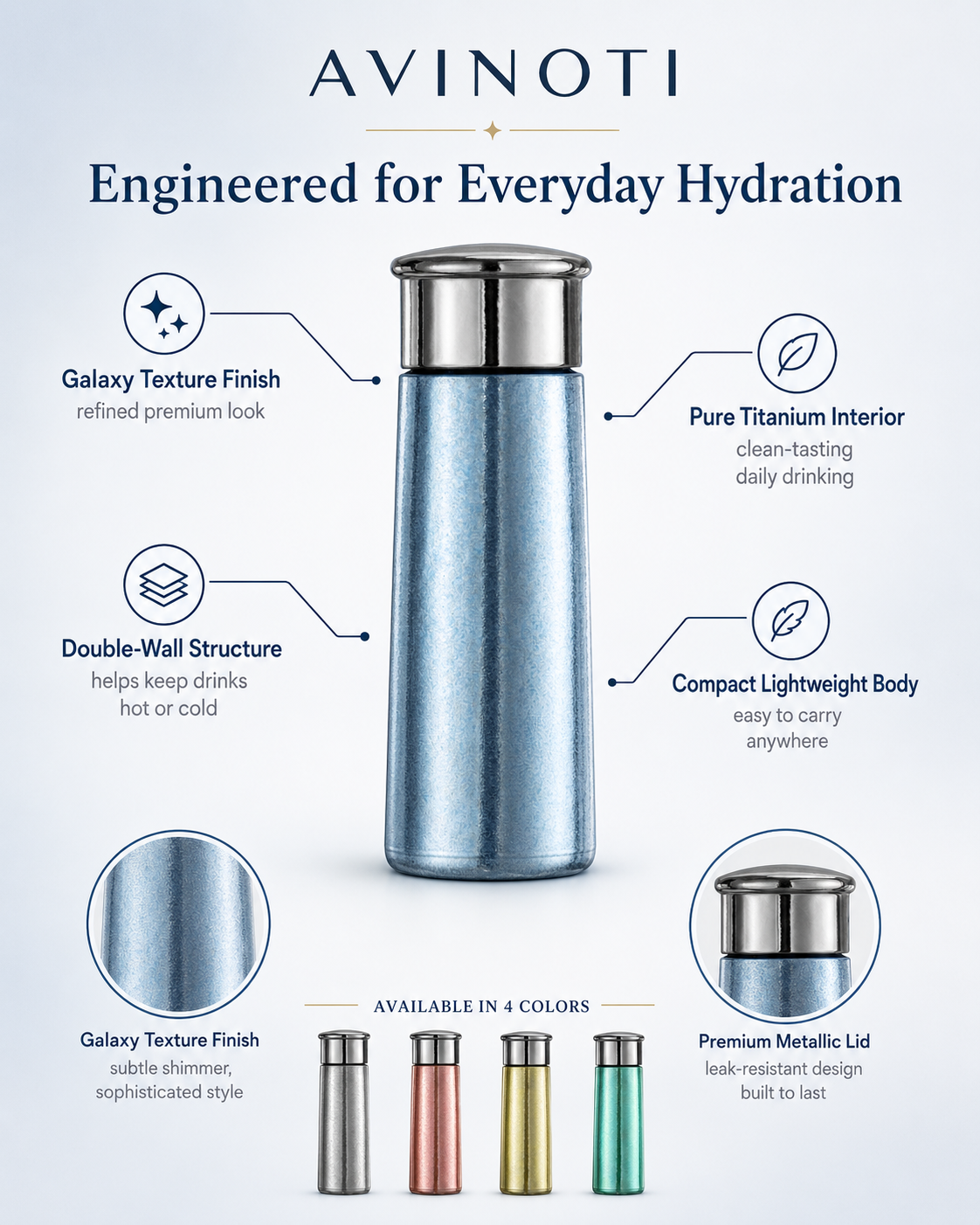
Inspect the lid, seal and drinking opening
The lid is often the most frequently handled and most failure-prone part of a reusable bottle. A premium body is less useful if the cap is awkward to clean, difficult to replace or unsuitable for the way you carry it.
Ask these questions before purchase:
- Is the lid designed to be leak-resistant when the bottle is placed on its side?
- Does the product include a silicone gasket or another removable seal?
- Can the gasket be removed for cleaning?
- Are replacement lids or seals available?
- Is the opening comfortable for direct drinking?
- Is the opening wide enough for ice or a bottle brush?
- Which materials touch the drink at the lid?
- Is the lid intended for hot liquids as well as cold liquids?
Do not infer leak performance from a product photo. A threaded cap, flip lid and straw lid create different cleaning and carrying tradeoffs. The current AVINOTI product record does not describe its sealing test or replacement-part policy, so these are reasonable pre-purchase questions.
Check care instructions and drink compatibility
Care requirements affect both convenience and service life. Some reusable bottles can go in a dishwasher; others should be hand-washed because of their finish, vacuum structure, seal or printed decoration. Strong cleaners and abrasive tools may also affect a colored exterior.
Confirm the manufacturer’s instructions for:
- Dishwasher use versus hand washing.
- Maximum recommended drink temperature.
- Carbonated drinks, dairy drinks or acidic beverages.
- Removing and cleaning the lid gasket.
- Drying the bottle completely before storage.
- Using ice cubes and metal utensils.
- Deodorizing without abrasive cleaners.
Until the live product instructions confirm otherwise, a conservative routine is to wash the bottle promptly with mild soap, rinse the lid and seal carefully, and store all components open until dry. This is general care practice, not a replacement for product-specific instructions.
Material questions deserve the same careful treatment. The product record states that the interior is pure titanium. If your purchase depends on every drink-contact component being titanium, confirm the cap, underside and seal materials separately.
Decide whether titanium fits your priorities
A titanium insulated bottle is not automatically the best option for every shopper. It makes more sense when the benefits you value justify the price and the product publishes enough specifications to support comparison.
Titanium may suit you when:
- Empty weight is important and the measured weight is lower than comparable alternatives.
- You prefer a titanium drink-contact surface.
- You want a reusable bottle for work, commuting or travel.
- You value the appearance and color choices enough to pay a premium.
- The verified capacity, lid and insulation performance fit your routine.
Another material or a simpler bottle may make more sense when:
- Price is the main decision factor.
- You need a very large capacity.
- Replacement caps and seals must be widely available.
- You want a single-wall container for a specialized outdoor use.
- The seller cannot provide the dimensions or performance data you need.
This is a decision about the complete product, not a material contest. Compare capacity, total weight, construction, closure, care and support at the same time.
For another example of separating a material label from practical buying checks, see the titanium cutting board pros and cons guide. If packing weight is your main concern, the titanium carry-on luggage buying guide uses the same measurement-first approach.
A five-minute pre-purchase checklist
Use this compact checklist before placing an order:
- Record the exact capacity.
- Record height and widest diameter.
- Record empty weight.
- Confirm whether the double wall is vacuum insulated.
- Request the published hot-and-cold test duration and conditions.
- Confirm the lid type and leak test.
- Confirm all drink-contact materials.
- Check whether the gasket can be removed and replaced.
- Read cleaning and drink-compatibility instructions.
- Verify the selected color, current price and availability.
- Read return and warranty terms.
If the missing details are important to your use case, pause the purchase until they are confirmed. That is especially sensible for a $100 bottle, where a poor fit or unsuitable lid can outweigh the value of the material.
Frequently asked questions
Is a double-wall titanium bottle always vacuum insulated?
No. Double-wall describes two walls; vacuum insulated describes the condition of the space between them. Look for an explicit vacuum specification or documented performance test. The current AVINOTI product data confirms double-wall construction but does not explicitly state vacuum insulation.
How long will a titanium insulated water bottle keep a drink hot or cold?
The answer depends on construction, lid, capacity, starting temperature, fill level and test conditions. Use the manufacturer’s documented test rather than a generic category claim. The current AVINOTI record does not publish a timed retention result.
Is the AVINOTI Galaxy Series bottle lightweight?
The listing describes it as lightweight, but the current product record does not provide an exact empty weight. Ask for grams or ounces and compare that number with bottles of a similar capacity.
What colors are currently listed?
The product data lists Galaxy Blue, Titanium Silver, Rose Pink, Champagne Gold and Emerald Green. Confirm live availability before ordering because inventory can change.
What capacity is the AVINOTI bottle?
Capacity is not included in the current product record used for this guide. Verify milliliters or fluid ounces on the live product page or with customer support before purchase.
Can the bottle go in a dishwasher?
The current product record does not state dishwasher compatibility. Follow the live care instructions; if no guidance is available, ask the seller before using a dishwasher, especially because the bottle has a colored Galaxy-inspired finish.
Is titanium worth the higher price?
It can be when measured weight, drink-contact material, design and verified bottle performance match your priorities. It is not worth paying more based on the material name alone. Compare the complete specification and support policy.
The strongest buying decision is the one supported by measurements. Confirm the missing capacity, dimensions, weight, insulation test and lid details, then decide whether the Galaxy Series fits the way you actually carry and use a bottle.