
Titanium Carry-On Luggage: What to Check Before You Buy
Titanium carry-on luggage sounds simple, but the label alone does not tell you whether a suitcase will fit your airline, feel manageable in an overhead bin or suit the way you pack. A useful evaluation starts with measurable details: exterior dimensions, empty weight, capacity, material construction, wheel layout, handles, closure and repair support.
This guide uses Avinoti’s current 36 L carry-on as a concrete example while separating published product facts from the questions a buyer should still verify.
Start with the airline, not the suitcase
There is no single carry-on limit that applies to every airline and aircraft. The Federal Aviation Administration advises travelers to check the airline’s current size and item limits, and the U.S. Department of Transportation notes that size, weight and piece allowances can vary.
Before comparing materials, write down the limit for every flight segment:
- Maximum exterior height, width and depth
- Whether wheels and handles count in the measurement
- Maximum carry-on weight, if the airline publishes one
- Personal-item allowance
- Aircraft-specific or fare-specific restrictions
A suitcase can be marketed as a carry-on and still exceed a particular airline’s limit.
Compare the published dimensions
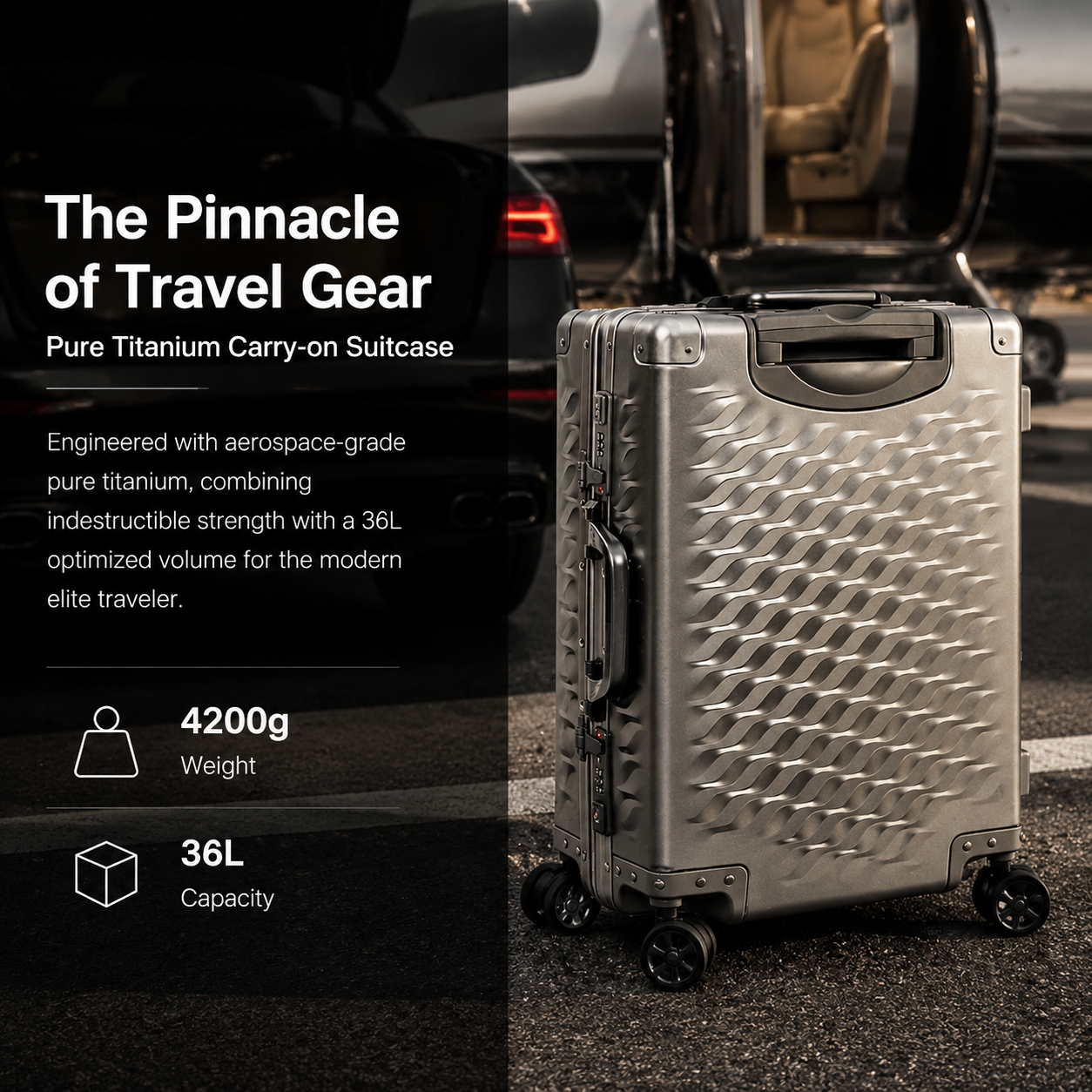
The Avinoti Titanium Carry-On Luggage 36L currently lists exterior dimensions of 55 × 38 × 23 cm, a 36 L capacity and an empty weight of 4.2 kg.
For comparison, convert the dimensions if your airline publishes inches:
- 55 cm ≈ 21.7 in
- 38 cm ≈ 15.0 in
- 23 cm ≈ 9.1 in
The total is about 45.7 linear inches. That is close to common carry-on ranges, but “close” is not approval. Confirm the exact limit for the airline and fare you booked, especially if the airline measures the full exterior including wheels.
Empty weight affects usable packing weight
An empty weight of 4.2 kg is about 9.3 lb. Whether that feels light depends on the route and traveler.
Use this simple calculation:
Allowed carry-on weight − empty suitcase weight = approximate packing allowance
For example, if an airline permits 8 kg, a 4.2 kg suitcase leaves about 3.8 kg for contents before accessories. If the airline has no published carry-on weight limit, you still need to be able to lift the loaded case safely into the overhead bin.
Do not evaluate “lightweight” as an isolated marketing term. Compare the measured empty weight with:
- Your airline’s allowance
- The weight of the items you normally pack
- Your ability to lift the loaded case
- A lighter polycarbonate, aluminum or textile alternative
Ask what “titanium” describes
The current product page describes titanium construction, but a careful buyer should still confirm the material scope:
- Is the full shell titanium, or are specific panels or components titanium?
- Is a titanium grade or thickness stated?
- Which parts use other metals, polymers, textiles or coatings?
- How are corners, hinges, zippers and wheel housings constructed?
- What cosmetic changes should be expected with use?
Those questions matter because the material name alone does not describe every component or predict how the complete suitcase will behave after repeated handling.
Avoid assuming that “titanium” automatically means scratch-proof, dent-proof or corrosion-proof in every condition. Surface finish, thickness, joints and mixed materials all affect durability.
Examine the shell and corner construction
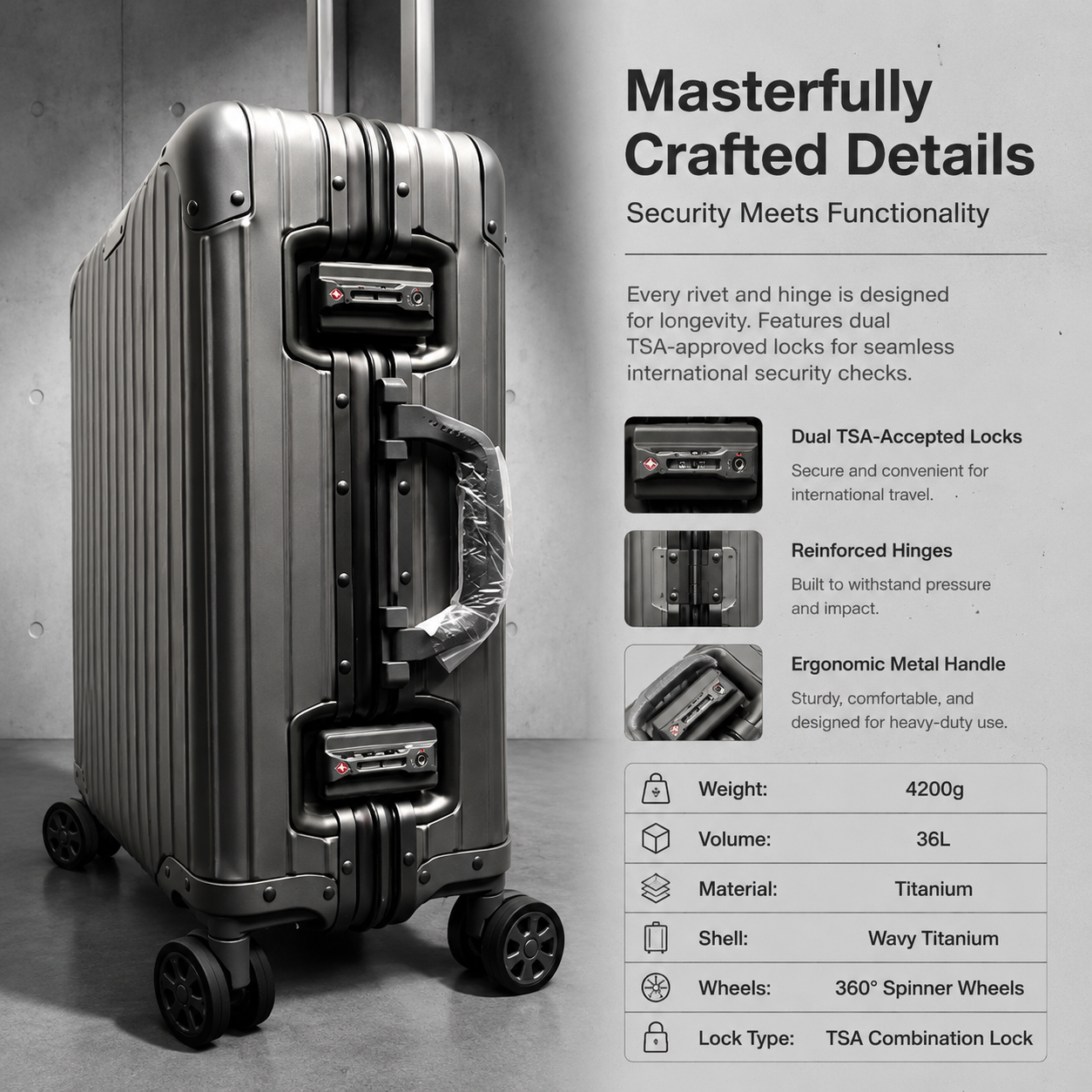
A hard-shell carry-on should protect its contents without creating avoidable weak points. Inspect:
- Corner reinforcement
- Panel flex
- Seams and joints
- Zipper or latch attachment
- Wheel-housing attachment
- Handle mounting points
The Avinoti listing describes reinforced corners and a smooth exterior. Product images can help you inspect the layout, but they cannot show long-term wear. Ask what the warranty covers and whether replacement wheels or handles are available.
Wheels can matter more than the shell
A strong shell does not help if the wheels are difficult to control. For a rolling carry-on, check:
- Two-wheel versus four-wheel design
- Wheel size and ground clearance
- Whether the wheels rotate smoothly under load
- How far the wheels project beyond the shell
- Whether individual wheels can be replaced
- Stability on uneven flooring
Projected wheels also count toward many airline measurements. Measure the complete case, not only the box-shaped body.
Check the handles under realistic load
Look at both the telescoping handle and any fixed lifting handles.
For the telescoping handle:
- Does it lock at more than one height?
- Is there noticeable side-to-side movement?
- Does the handle intrude into the packing space?
- Can it be repaired without replacing the whole case?
For fixed handles:
- Are the attachment points reinforced?
- Is the grip comfortable with a fully loaded case?
- Is there a handle on more than one side for lifting?
If you regularly lift a bag into an overhead bin, grip comfort and handle placement can matter more than appearance.
Review the closure and security details
The Avinoti listing describes smooth zippers. Before buying, confirm:
- Zipper type and track construction
- Whether the zipper can be locked
- Whether a lock is included
- Whether the lock is serviceable
- How the zipper behaves around the corners
Do not overpack. Excess pressure on zippers, seams or latches can reduce reliability even when the shell is strong.
Decide whether 36 L fits your packing style
Capacity is useful for comparison, but the internal shape determines how much of that volume is convenient.
A 36 L case may work for a short trip when you pack compactly. Before deciding, check:
- Divider placement
- Compression panels or straps
- Pocket dimensions
- Space lost to the telescoping-handle channels
- Whether shoes or a laptop fit your usual arrangement
- Whether the case opens flat in a small room
Make a trial packing list rather than relying on a generic “weekend” claim. Clothing type, climate, footwear and personal items change the required space.
Compare hard-shell material tradeoffs
| Material direction | Typical reason to consider it | Question to verify |
|---|---|---|
| Titanium-labelled metal construction | Premium feel and rigid protection | Exact material scope, grade, thickness and repair options |
| Aluminum | Rigid shell and established luggage formats | Empty weight, denting and latch service |
| Polycarbonate | Lower empty weight and some shell flex | Panel thickness, corner protection and crack warranty |
| Textile/soft-sided | Flexible packing and exterior pockets | Water resistance, abrasion and frame support |
No material wins every category. The right choice depends on weight limits, handling, repairability and budget.
Inspect the current product data before checkout
The Avinoti listing currently provides:
- 36 L published capacity
- 55 × 38 × 23 cm published dimensions
- 4.2 kg published empty weight
- Hard-shell titanium positioning
- Reinforced-corner description
- Rolling wheels, zippers and ergonomic handles
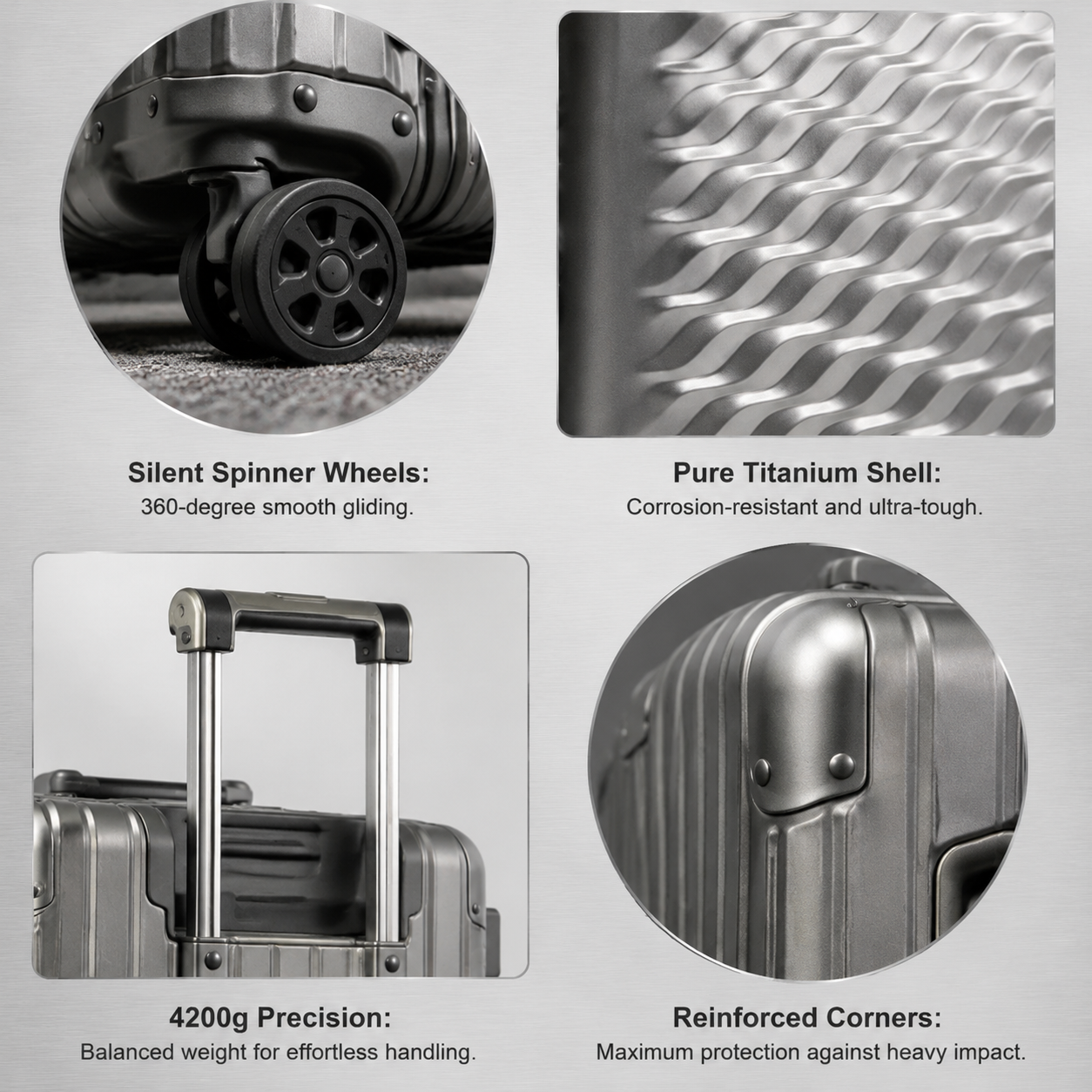
Before checkout, verify the current page because specifications, price and availability can change. If a detail is important—such as full-shell material composition, wheel replacement or warranty coverage—ask for written confirmation.
A practical pre-purchase checklist
Airline fit
- I checked every airline and flight segment.
- I included wheels and handles in the dimensions.
- I checked both size and weight limits.
- I understand the bag may still be gate-checked when bins are full.
Carry comfort
- I can lift the estimated loaded weight.
- The handle height fits me.
- The fixed handles are positioned for lifting.
- The wheel layout suits the surfaces I use.
Construction
- I know what parts are made from titanium.
- I reviewed the closure and corner construction.
- I checked the warranty and repair options.
- I know whether replacement wheels or handles are available.
Packing
- 36 L fits my real packing list.
- The internal dividers suit my items.
- I am not relying on overpacking to make the case work.
Frequently asked questions
Is a 55 × 38 × 23 cm suitcase always accepted as carry-on?
No. Airline and aircraft limits vary. Check the exact allowance for every flight and include wheels and handles in the measurement.
Is 4.2 kg light for a carry-on?
It depends on the airline’s weight allowance and the traveler. Compare the empty weight with lighter alternatives and calculate how much packing weight remains.
Does titanium luggage never scratch or dent?
No material is immune to cosmetic wear or impact. Construction, thickness, finish and handling all matter. Verify specific material and warranty claims.
Is 36 L enough for a weekend?
It can be, but the answer depends on clothing, footwear, weather and packing style. Test the volume against your own packing list.
Should valuables go in a carry-on?
The U.S. Department of Transportation recommends keeping critical, fragile and valuable items with you, while recognizing that a full-size carry-on may sometimes be gate-checked. Use an accessible personal-item bag for essentials.
What is the most important question to ask before buying?
Ask whether the complete exterior dimensions and empty weight fit the exact airline rules and your ability to lift the loaded case.
Bottom line
Titanium carry-on luggage should be evaluated as a complete travel tool, not by its material label alone. Start with airline dimensions and weight, then compare construction, wheels, handles, closure, interior layout and repair support. The Avinoti 36 L model provides concrete dimensions and weight for comparison; the final decision depends on your itinerary and packing habits.