
Titanium Spoon and Fork vs. Spork for Packed Lunches
Choose a provisional cutlery format around tomorrow's packed lunch, then check the head, grip and container before choosing a particular product.
Use the examples and blank record below as editorial planning aids, not as results of an Avinoti product test.
Should I choose a separate spoon and fork or a spork?
Consider separate utensils when you want a spoon available alongside a fork; consider a one-piece option when carrying one eating utensil matters more to you.
Editorial example: imagine packing soup in a flask and salad in a second container, and wanting to alternate between them without exchanging one utensil between both jobs. For that preference, shortlist a separate spoon and fork, then check each head and its reach in the relevant container; leave the choice open if either check is unresolved.
Editorial example: imagine a single bowl of rice and soft vegetables, no separate soup, and a preference to carry only one utensil. Try the scooping and piercing actions you want with an existing utensil, then inspect a combined-head candidate; choose separate pieces instead if you prefer independent heads.
Before grouping all one-piece options together, inspect whether the listing shows a shared spoon-and-fork head or a spoon at one end and a fork at the other. For a double-ended candidate, check where you would hold it for each end and where you would put it down between uses; do not infer comfort or cleanliness from the layout alone.
Treat these as two different meal-and-carry preferences, not a claim that one format wins for everyone.
How do I check whether the handle fits my lunch container?
- Start with your actual lunch container cool and empty, plus an existing utensil; do not trial the check over hot food.
- Hold the utensil in your normal eating grip and identify the finger nearest its working head as your grip boundary.
- Compare the portion from that boundary to the working end with the utensil's overall length; do not substitute the total measurement for the portion available beyond your fingers.
- Without changing to an awkward fingertip grip, try reaching the bottom and corners of the empty container and lifting the head back past the rim.
- Record whether your fingers enter farther than you want, the rim obstructs your usual movement, or you need a different grip.
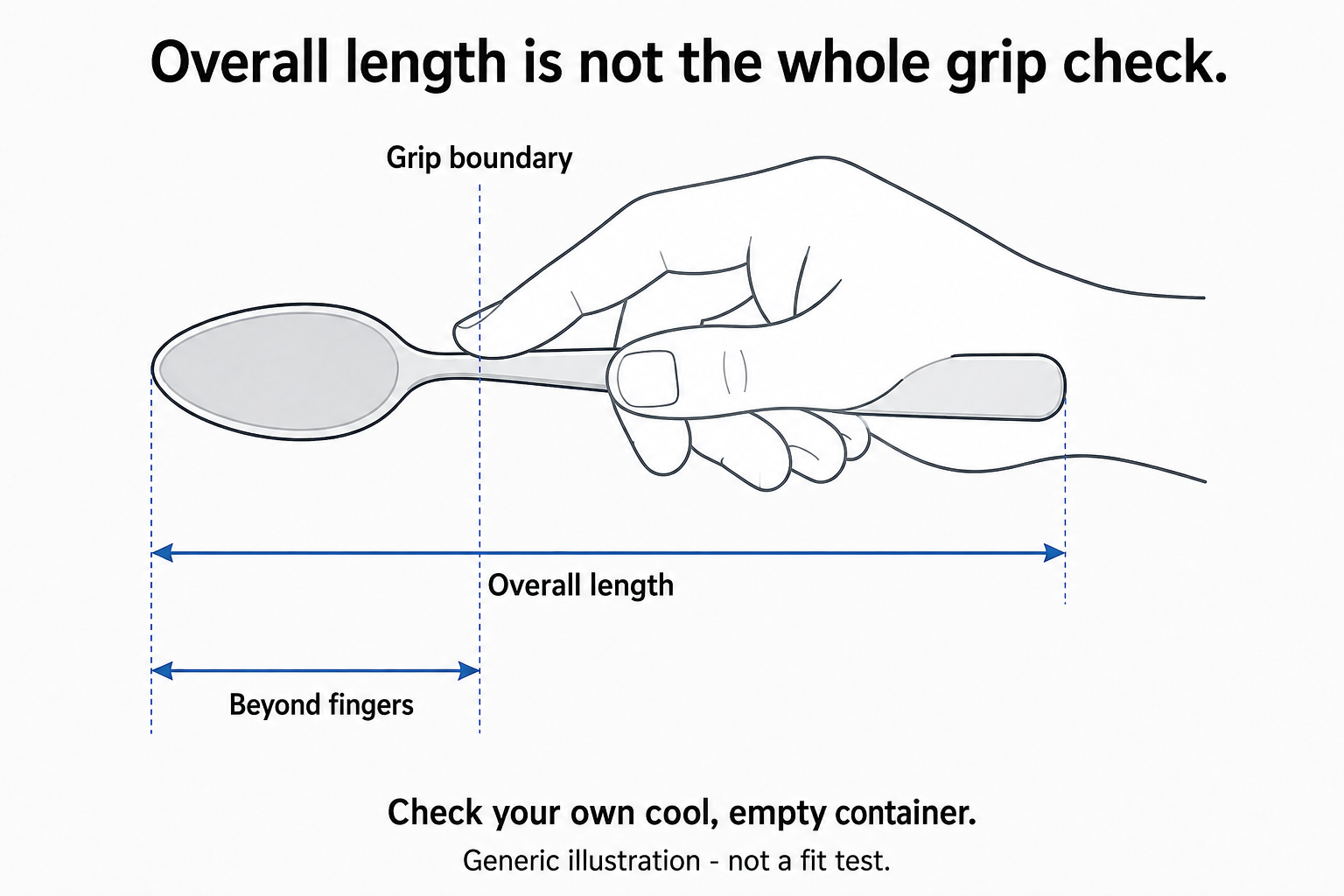
Use that record to ask about the candidate's head-to-grip geometry; success with your existing utensil does not establish that a different product will fit. If a listing provides only an overall length or a photograph without scale or a hand position, leave normal-grip reach unconfirmed.
What should I inspect about the utensil head and grip?
- For a meal you intend to scoop, ask for a side view of the spoon bowl and a clear view of its rim; do not infer bowl depth or how much it holds from a top-down silhouette.
- For pieces you intend to pierce, inspect the visible tines and their spacing, then note whether the photographs actually show the working tips clearly.
- For a combined head, consider both planned actions against the same photographed head rather than assuming the product name settles them.
- Look for the handle area your fingers would occupy and any change of shape there; a photograph with no usable scale or hand view cannot settle your personal grip question.
These are questions to resolve with better views, dimensions or an appropriate personal trial, not measured claims about food retention, comfort or durability.
What should I check for carrying and cleaning cutlery at work?
- Decide where clean utensils will sit before lunch and how you will contain used utensils on the way home.
- For separate pieces, plan space for both; for a double-ended candidate, consider how you would cover either used end.
- Check the seller's care instructions before choosing a cleaning method.
- Verify whether a pictured case, clip or other accessory is included; do not add it to your buying plan until confirmed.
What should I verify on a product listing before buying?
Fill in a decision record before comparing listings:
- Meal and actions: ; do I want two independent utensils available together? .
- Actual container: ; existing utensil and normal grip used for the cool empty check: .
- Bottom/corner reach and rim clearance: ; unwanted finger entry or grip change: .
- Provisional format and carrying tradeoff: ; head or grip detail still unresolved: .
- Used-utensil carrying plan: ; seller care and included-accessory questions: .
Editorial example record: soup plus salad; independent utensils preferred; flask reach not checked yet; provisional separate spoon and fork; measure and check before choosing a model.
Use the candidate fork and spoon listings to check each item's current details, not to assume that either has passed your container or grip check.
If a decisive dimension, view or care instruction remains missing, keep that question open rather than turning a provisional format into a product recommendation.